
Are You Built for the First Two Years?
Surviving the Early Days
The essential starting point for every new parent: the self-awareness and understanding of emotional health you need to navigate the most demanding two years of parenthood.
This is the essential starting point for every new parent. We arm you with the self-awareness and understanding of emotional health you need to navigate the most demanding two years of parenthood.
You’ll gain a powerful, practical tool, the Sailboat Metaphor, to instantly assess your stability and readiness for the long haul.
Intro Chapter: Welcome
Starting Your Journey
This lesson outlines the purpose of the course and asks you to reflect on your current expectations and concerns about becoming a parent.

Purpose of the Course:
This course is designed for expecting fathers, partners, and caregivers. The goal is to provide a practical toolkit to navigate the profound emotional transition to parenthood.
We focus on self-awareness and establishing a strong baseline for your emotional health.
Initial Reflection:
Before proceeding, take a moment to consider your answers to these two key questions:
- What are you looking forward to about having a baby?
- What challenges do you think you might face?
Chapter 1: Emotional Literacy
What is Emotional Wellbeing?
We’ll stop using jargon and define what good emotional health really looks like. It’s not about being happy all the time, but about your ability to stay in the game when life gets tough.

Emotional Health: It’s About Resilience, Not Perfection
Many guys think emotional health means being permanently happy or never stressed. That’s a myth.
The World Health Organisation (WHO) defines good mental health as: “…a state of well-being in which the individual realises their own ability, can cope with the normal stresses of life, can work productively and fruitfully, and is able to make a contribution to their community.”
Think of it as coping capacity. You’re mentally healthy when you can take a hit, a huge sleep debt, a demanding week at work, a fussy baby, and still find a way to get the job done without shutting down or lashing out.
Key Takeaway:
Emotional wellbeing is your resilience. You’re building a foundation that helps you stay steady when the chaos hits.
Recognising Poor Emotional Health
This lesson identifies the three factors that push normal stress into true distress and gives you a clear warning sign: the moment you start feeling “broken” or “checked out.”

When Stress Becomes Overload (The Performance Drain):
You’re used to operating at 100%, but fatherhood drops you to 20% capacity overnight.
When does this exhaustion become a problem?
When the stress increases in three ways:
- 1. Severity (how bad the feelings are: feeling truly hopeless or numb)
- 2. Frequency (how often it occurs: is it every day, all day?)
- 3. Longlasting (the duration: does this heavy feeling stick around for weeks?).
The Warning Signs:
You might notice you’re getting shorter with your partner, isolating yourself, or feeling ‘crappy.’ You might start using concerning language like, “I feel hopeless,” or “A tiny little human can break me.”
If you’re consistently feeling checked out, overwhelmed, or hopeless, that’s your signal to stop and pay attention.
Chapter 2: The Transition
The Perinatal Time Frame
We cover the critical window of the Perinatal Period and explain why this specific stretch of time demands your focus on self-care.

The Two-Year Marathon:
The Perinatal Period is the entire time frame when parents are most vulnerable to mental health challenges.
It’s much longer than just the first few months. This period starts with the Antenatal Period (pregnancy) and extends to the first two years Postnatal (after the birth).
Why It’s a High-Risk Time:
This transition isn’t just about managing a baby; it’s a fundamental change to your identity, your career stability, your finances, and your primary relationship. It’s a two-year marathon where the rules change every month. This is why having a plan now is crucial.
Common Stressors of Parenthood
This lesson identifies the four biggest hits to your energy and control. We call this the “Falling in a Hole” concept, recognising that the struggle is real and universal.

The Four Core Stressors (Your Control is Gone):
When you feel overwhelmed, it usually comes down to one of these four pressure points.
Understanding them helps you prepare:
- 1. Sleep Loss and Physical Fatigue: Chronic exhaustion is a mental corrosive. It makes minor issues feel like catastrophes.
- 2. Shift in Identity & Loss of Independence: The loss of old freedoms, the ability to go to the gym, watch the game, or focus on a hobby, can lead to feeling resentful and disconnected from your ‘old self.’
- 3. Financial and Work Pressure: The stress of providing, juggling leave, and childcare costs is immense.
- 4. Relationship Change: The shift from being a couple to being co-parents is brutal on intimacy and communication. You might look at your partner and see only the co-parent, not the person you fell in love with.
Reflection Moment:
Have you found yourself reacting to small problems with disproportionate anger or frustration lately? That’s often a sign of pressure building in one of these four areas.
Chapter 3: Self-Assessment
Why Your Health Matters
This lesson explains the direct link between your emotional state and the security of your baby, showing you that self-care is not selfish; it’s great parenting.

Self-Care is Not Selfish; It’s Great Parenting.
When you’re exhausted and stressed, you have less patience, less time, and less emotional bandwidth for your partner and baby.
Impact on Baby:
A baby’s brain develops based on the consistency of the parent’s response. When you are calm and regulated, you are modelling emotional security. Your calm is the baby’s safe space. It builds secure attachment.
Impact on Partnership:
Your stable emotional health is the buffer that allows the partnership to withstand the sleep debt and stress. If one parent crashes, the whole team goes down. Prioritising your health is prioritising the entire family’s long-term stability.
Tool: The Sailboat Metaphor
This tool helps you quickly assess your current stability and identify your existing personal support systems. Your maintenance plan before the baby arrives.
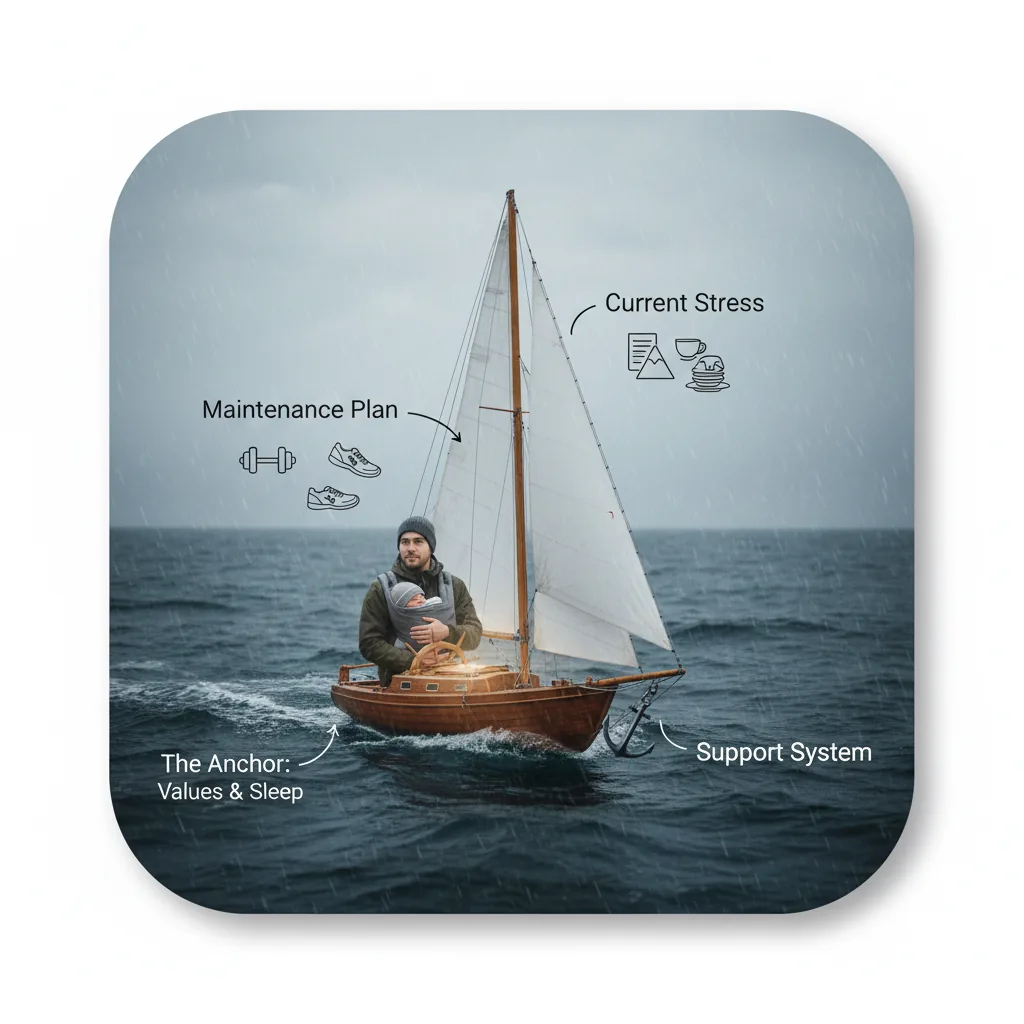
Testing Your Stability (The Sailboat Metaphor):
Think of your emotional self as a sailboat on the ocean.
- The Load: This is your current stress: work demands, financial worries, or health issues. The heavier the load, the deeper the boat sinks.
- The Hull (The Anchor): This is your support/maintenance plan (adequate sleep, exercise, healthy diet, dedicated hobbies). A solid hull keeps you upright in a storm.
- The Goal: You need to confirm your Maintenance Plan is ready before the baby arrives.
Action Point:
What are two specific activities that are part of your emotional “Maintenance Plan” right now (e.g., the gym, a specific hobby, weekly time with friends)? These are the non-negotiables you must protect when the chaos starts.
Chapter 4: Transitioning to Action
Where to From Here?
This final lesson summarises the core insight of Course 1, that self-care is foundational and provides a clear path to the next course, The Role of Dads.

Your Foundation is Set:
You have completed the crucial self-assessment phase. The most important takeaway from this course is that you must prioritise your own emotional health first.
You cannot pour from an empty cup, especially when dealing with chronic sleep deprivation.
You now understand the Perinatal Window and the need for a protective Maintenance Plan (The Hull).
The Two-Person Check-In:
The tools you’ve learned are not just for you; they are for your partner, too. Use your new self-awareness to become an active observer for her. You now know the signs of distress (Severity, Frequency, Longlasting) and what a healthy Hull (sleep, diet, time off) looks like.
Action Directive:
Initiate a conversation with your partner about her Maintenance Plan.
Ask her:
“What fills your cup, and what can I do this week to protect that time for you?”
This shifts you from a passive supporter to an active protector of her wellbeing.
Next Course:
Now that you know where you stand and have a framework for checking on her stability, you need the tools to engage with your partner on shared goals.
When you are ready, continue to the next course: The Role of Dads.